
At Zartis AI Summit 2026 on 21st May, our CEO Padraig Coffey opened his talk with the question that most executive AI conversations avoid: what does it actually mean to use AI, rather than just advocate for it? The answer, as it turned out, required him to spend several months examining his own working habits in some detail.
The talk traced Padraig’s own experience running an AI transformation programme on himself: mapping his time, building a custom AI companion on Anthropic’s Claude, failing once, redesigning, and eventually arriving at something that worked. That process became the blueprint for a new Zartis service, launched at the summit, of the same name: Agentify the C-Suite.
The Problem Nobody Wants to Admit
Most executives making AI decisions today are doing so without genuine AI fluency. Not because they are disengaged, but because the technology has moved faster than any reasonable process of organisational absorption. That is a structural reality, not a criticism, and it is the problem this programme was built to address.
The tools are advancing faster than most organisations’ capacity to evaluate them. Anyone paying attention can see the potential in Claude Code and Cowork, Anthropic’s enterprise AI platform, as well as tools like Cursor. But as Padraig put it: “the bottlenecks are organisational, and the limits of our own imaginations.”
Awareness is not the same as fluency, and fluency is what determines whether AI investment compounds or dissipates.
The deeper problem is that most executive AI adoption is performative. Demos, pilots, the occasional ChatGPT prompt. It feels like engagement, but it does not change how anyone actually works.
An Origin Story Worth Hearing
Padraig’s programme began not as a strategic initiative, but as a moment of personal discomfort. He described it as “imposter syndrome mixed with impatience and excitement.” He was running an AI transformation company, advising clients on how to embed AI into their operations, and was quietly aware he was not doing it himself to the right extent.
Padraig mapped his working time across five domains: strategy, growth, operations, investor relations, and communications. The CEO of an Irish company is legally obliged to operate in the interests of shareholders and employees. You can delegate, but you cannot abdicate. So the question was not which tasks to eliminate, but how to handle each domain with less friction, less cognitive overhead, and more useful output.
Version One Failed. That Was Part of the Point.
The first version of the programme saw genuine early progress. AI adoption began. Cowork integrated into the daily workflow. Some tasks that had taken 50 minutes came down to 10. But the momentum did not hold. Without protected time commitments, structured KPIs, and consistency, the programme reverted. Old workflows pulled harder than new habits.
The lesson from V1 was not that the tools did not work. It was that the challenge is behavioural, not technical. That insight became the foundation for everything that followed.
Version Two: A Structured Programme That Actually Held
What started as an informal experiment became a structured programme the moment it got a name. Naming it imposed the discipline that V1 had lacked: defined phases, protected time commitments, and measurable KPIs. Without those, the early gains faded and old workflows reasserted themselves.
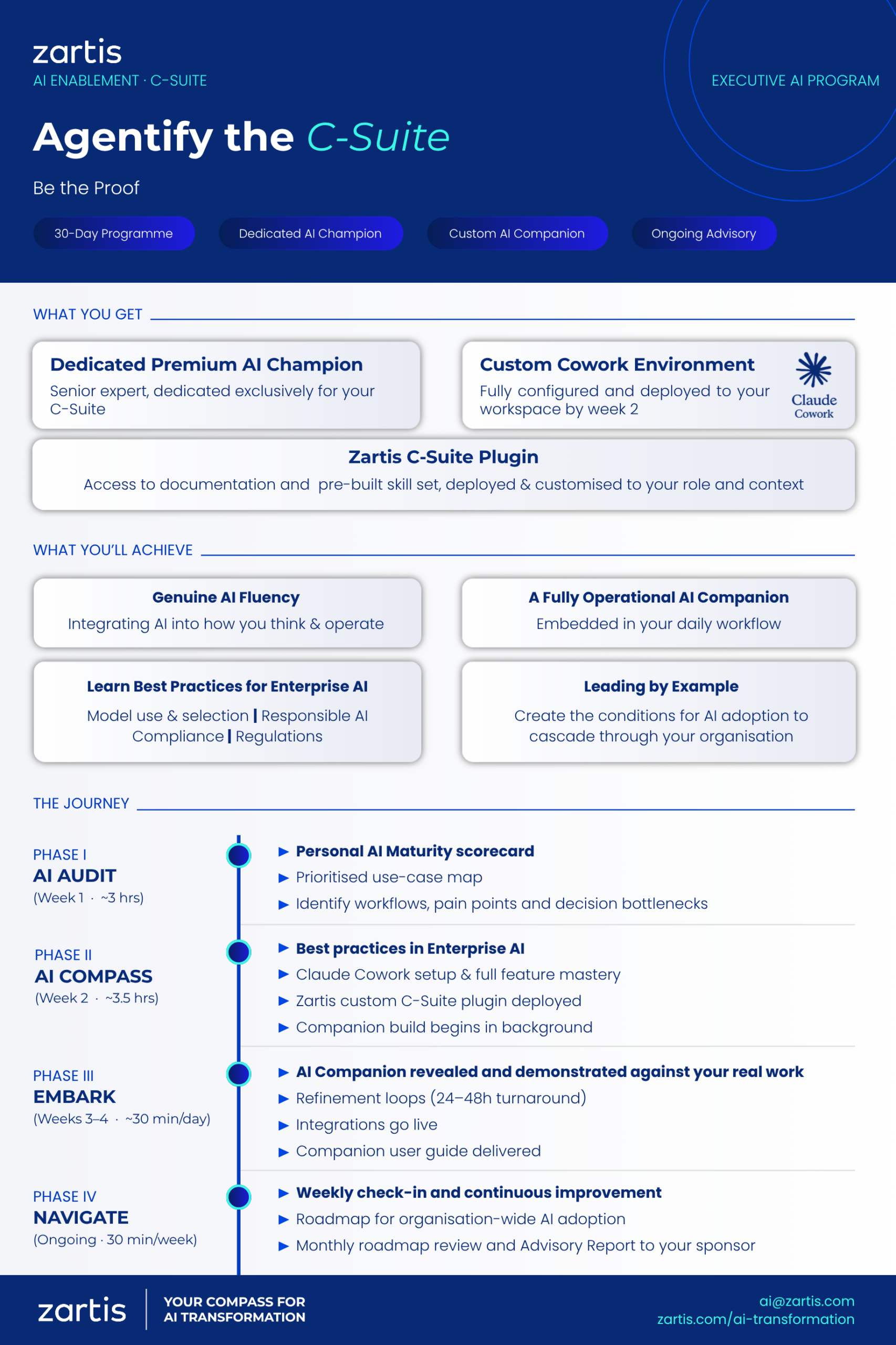
The redesigned programme has four phases, each building toward a custom AI companion built on Anthropic’s Claude and deployed through Cowork.
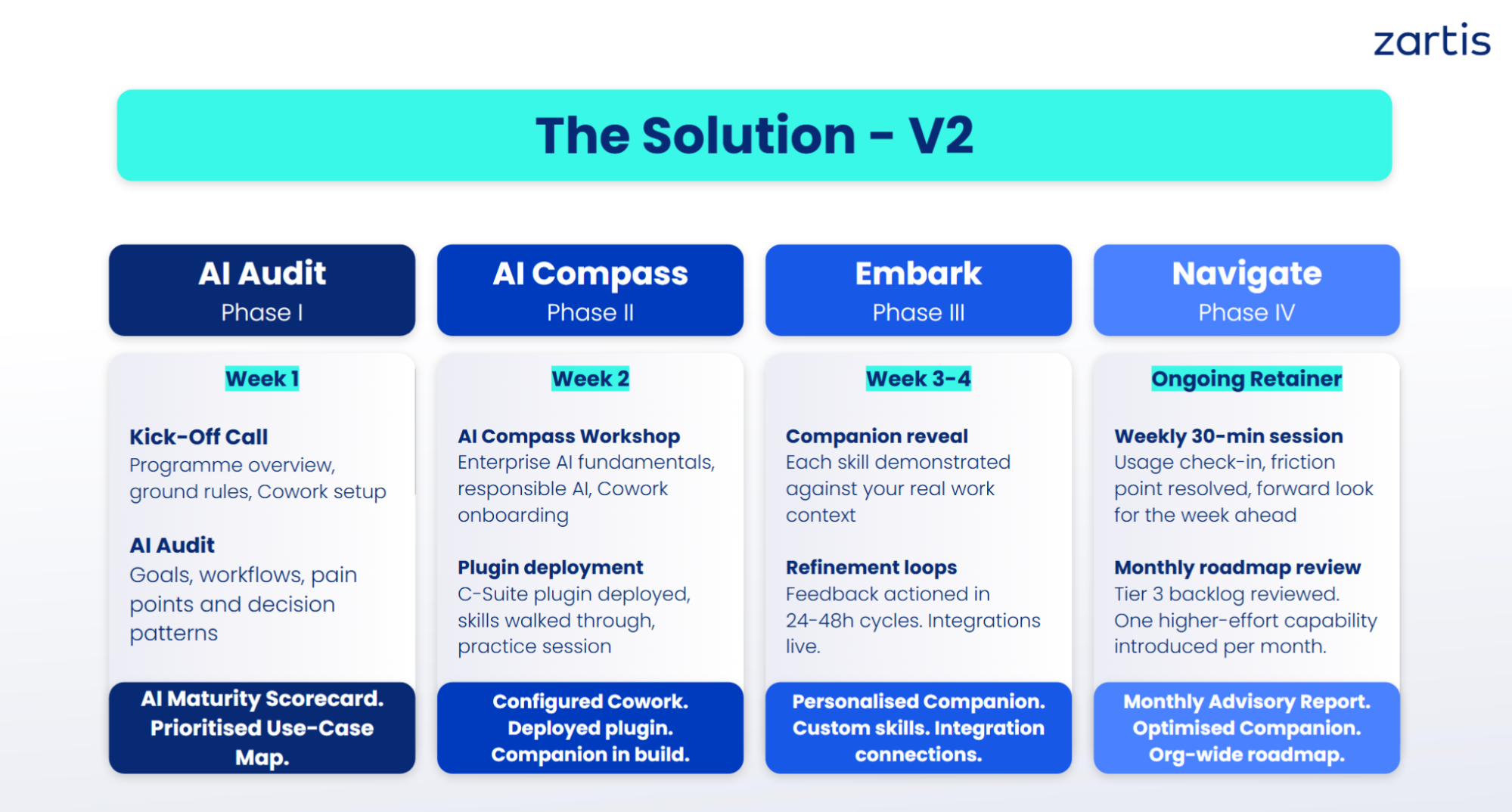
Phase I, the AI Audit, takes roughly three hours in week one. It maps goals, workflows, pain points, and decision patterns to produce an AI Maturity Scorecard and a prioritised use-case map. The point is not to find every possible AI application. It is to identify the ones that will actually change how someone operates.
Phase II, the AI Compass, covers enterprise AI fundamentals, responsible AI, and tool mastery. By the end of week two, the custom Cowork environment is configured and deployed. A bespoke C-Suite plugin is live. The companion is deployed through Cowork, giving participants direct hands-on experience with the tools rather than a theoretical introduction to them
Phase III, Embark, runs across weeks three and four at roughly 30 minutes per day. The companion is revealed, demonstrated against real work, and refined on 24 to 48 hour feedback cycles. Integrations go live.
Phase IV, Navigate, is an ongoing retainer: a weekly 30-minute session for usage check-ins and friction resolution, plus a monthly roadmap review and Advisory Report.
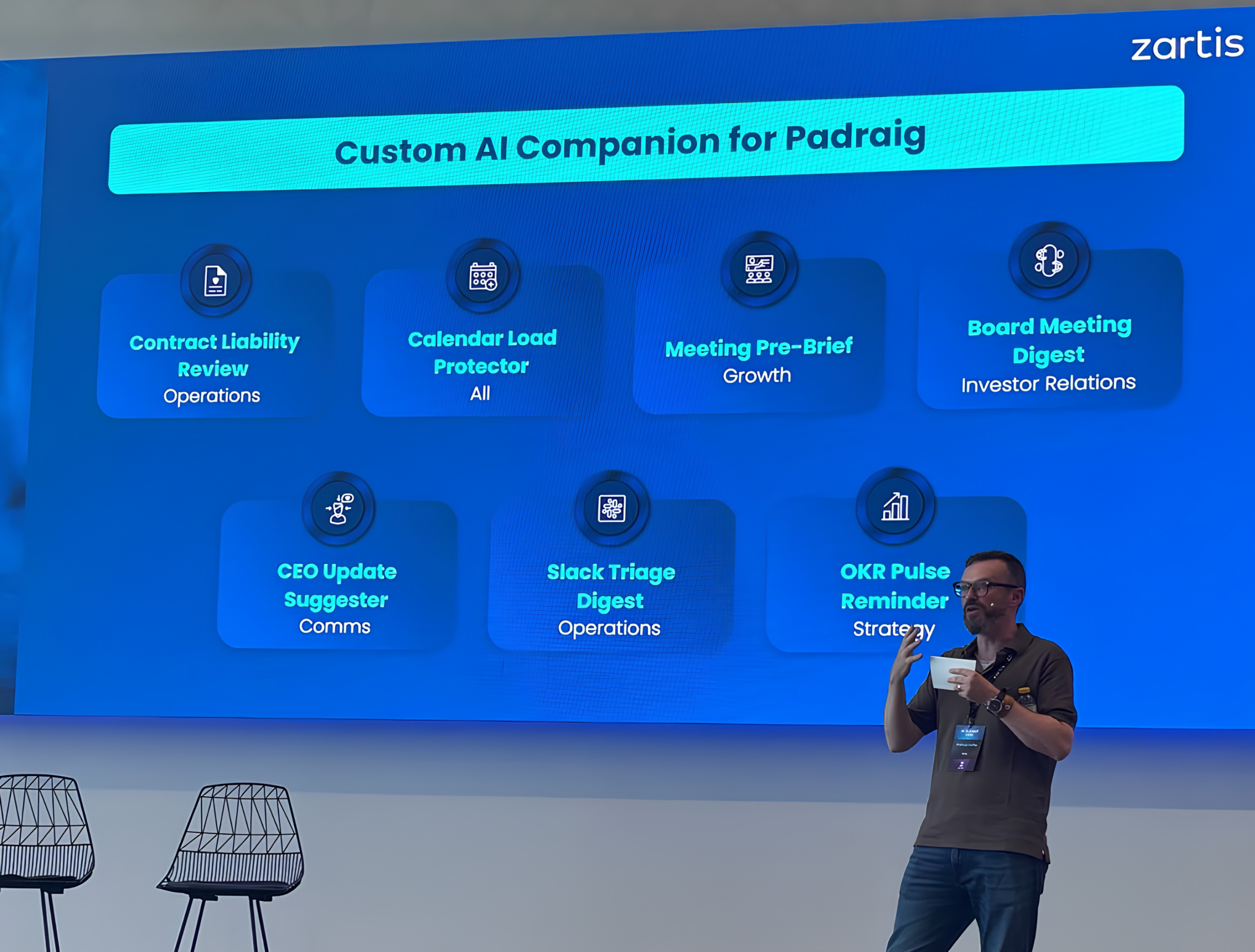
For Padraig, the companion that emerged from this process included seven specific skills across his five domains: a Contract Liability Reviewer, a Calendar Load Protector, a Meeting Pre-Brief tool, a Board Meeting Digest, a CEO Update Suggester, a Slack Triage Digest, and an OKR Pulse Reminder.
Each one fetches context from the systems he already uses (Calendar, Gmail, Slack, HubSpot, Drive) and then routes to either an analysis or an action. Analysis outputs go to Padraig for approval before anything executes. Action outputs are delivered directly, with a receipt.
What the Process Actually Taught Him
The examination of Padraig’s working life produced insights that had nothing to do with AI. Before any tool change, he was handling up to 18 video calls per day and working across scores of Slack channels. Simply mapping this was instructive. He muted approximately 100 channels. Context switching is cognitively expensive. Protecting bandwidth is a performance decision.
The broader observation that emerged from Phase III was one that Padraig now considers the most important insight from the whole programme: the more you work with an AI companion, the more precisely you understand where the human needs to be in the loop. That understanding does not come from a whitepaper or a workshop. It comes from use.
He quoted Hegel to make the point philosophically: thought does not exist fully until it is expressed. Language does not dress up a pre-existing idea. It completes the idea. Prompting an AI well requires you to articulate what you are actually trying to do. For many executives, that act of articulation is itself clarifying.
Enhancement, Not Replacement
The framing that Padraig returned to throughout the talk was direct: to agentify is not to disengage and delegate your working life to agents. It is to deliver better performance by using AI and automation deliberately. The goal is enhancement. The fear of replacement is a distraction from the more useful question of what you should actually be spending your time on.
The biggest shift, he concluded, is not a software implementation challenge. It is an executive behavioural transformation challenge. That is a harder problem to solve than a tool purchase. It requires structured engagement, protected time, honest measurement, and a guide who has done it.
The Programme Is Now Available
Agentify the C-Suite is a 30-day executive AI programme from Zartis. It includes a dedicated senior AI Champion, a fully configured Claude Cowork environment deployed to your workspace in week two, a custom C-Suite plugin, and an AI companion built around your actual workflows and decision patterns. The ongoing advisory retainer tracks usage, resolves friction, and extends capability month by month.
If you are an executive making AI decisions without genuine AI fluency, that gap will not close on its own. It closes with deliberate practice, structured support, and the willingness to examine how you are actually spending your time.
For more information feel free to contact our team at ai@zartis.com.