

Introduction
Software systems are foundational to organisational innovation and competitiveness in 2026. Because digital platforms now manage everything from supply chains to regulatory reporting, even minor defects from routine updates can trigger service interruptions, financial losses, or erode customer trust.
Regression testing is vital for mitigating these risks by ensuring existing functionality remains intact during system changes. Historically, manual testing performed late in the cycle was the standard; however, today’s shorter release cycles and complex architectures make that approach inadequate. Manual testing is simply too slow and expensive to scale. Consequently, automated regression testing has shifted from a technical innovation to a strategic business capability, enabling confident releases and continuous validation.
To meet modern demands, 2026 has introduced “intelligent automation”, utilising GenAI-driven authoring and self-healing scripts to minimise human intervention. Testing has also expanded beyond the deployment gate into live production environments through synthetic monitoring. Beyond mere defect detection, automated regression testing bolsters business resilience and compliance, ensuring crucial systems remain stable while adapting to constant change.
Through four major pillars, Compliance, Cost, Scalability, and Velocity — this article discusses how automated regression testing is now essential to organisations in 2026 and how these pillars cooperate in order to deliver reliable and sustainable software delivery.
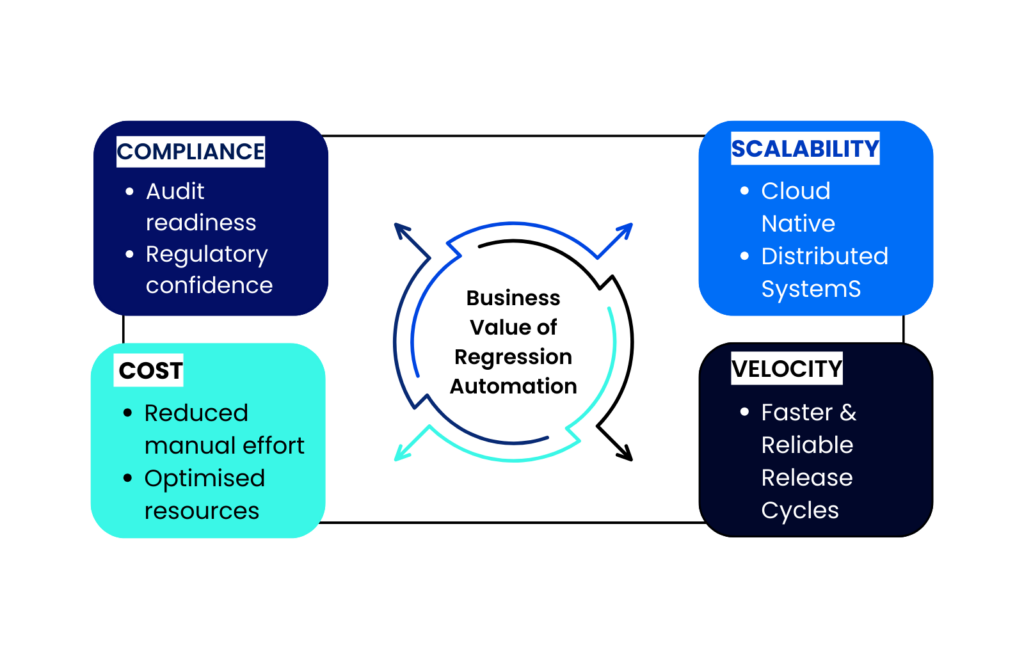
Compliance : Ensuring audit readiness through automation
Compliance is no longer a manual or recurring task. Accuracy, traceability, and consistent verification are necessary for this ongoing task. Automated regression testing is crucial for preserving audit readiness since software systems undergo frequent changes. It verifies that code updates adhere to defined regulatory rules. Automated test suites can verify important calculation logic, audit logs, data retention policies, and access controls in financial and healthcare systems. These inspections aid companies in maintaining constant compliance with legal requirements.
AI-powered testing that concentrates on high-risk areas improves compliance further. In response to system modifications, the AI optimises test coverage by generating new cases and selecting relevant existing ones. Anomalies that can point to possible compliance problems are also detected. AI-driven continuous validation in regulatory reporting guarantees that reports are produced from reliable data sources. Throughout the reporting lifecycle, workflows maintain compliance. This method lowers human error, enhances governance, and offers transparent, traceable proof for regulatory assessments and audits.
Cost : Reducing manual regression overhead
Modern software testing is moving towards automation in large part due to cost savings. Regression testing by hand takes a lot of time and resources, especially when applications get bigger. To further minimise manual intervention, GenAI-driven test authoring automatically generates comprehensive test scripts from requirements or user stories, significantly reducing the initial time investment and labor costs associated with script creation. Hand-executing the same test cases repeatedly results in lengthier feedback loops. Regression testing cycles are greatly decreased thanks to test automation, freeing up testers to concentrate on exploratory testing.
AI-driven automation uses intelligent test selection to further enhance cost effectiveness. AI analyses code changes to choose the most suitable tests rather than performing an entire regression suite. Self-healing features, in which AI-powered scripts recognise and correct themselves when UI elements or locators change, help to increase this efficiency. This eliminates automated suites from experiencing the costly manual “fix-and-rerun” cycle. This selective execution and automated maintenance save infrastructure costs and shorten pipelines. Other factors, like flaky tests, directly affect costs. Through the identification of flaky patterns and the enhancement of test stability, AI helps organisations maximise resources and create more predictable testing procedures.
Scalability : Adapting to distributed and cloud-native architectures
As companies employ distributed and cloud-native architectures, scalability has emerged as a crucial trait. Modern applications are made up of microservices and event-driven components that must function dependably in dynamic contexts. This degree of complexity is too much for traditional testing methods to handle.
The environment of testing in 2026 has “shifted right.” Nowadays, scalability testing fills the gap between pre-release and production by confirming the health of the live system using synthetic transactions, which are automated scripts that simulate actual user behaviour. Parallel and cloud-based test pipelines are essential for handling this complexity. Teams drastically minimise execution time by spreading test execution across multiple environments. AI-driven monitoring systems further improve this scalability by correlating regression data with live performance, identifying microservice failures that only manifest under real-world, distributed traffic loads.
Effective test orchestration and visibility become essential at scale. Orchestration ensures that resources are distributed effectively and dependencies are controlled. Centralised insight into test findings and failure trends is equally crucial. By correlating pre-release test data with production synthetic monitoring, teams gain a holistic picture of quality. Organisations maintain quality, dependability, and confidence as their systems increase by combining scalable execution, orchestration, and visibility.
Velocity : Achieving speed through reliable testing
Velocity has become a defining metric for modern software teams as organisations adopt shorter release cycles and continuous delivery models. Frequent deployments leave little room for lengthy or unreliable testing processes. In this environment, dependable automated testing is essential to maintaining speed without compromising quality. Reliable test suites provide fast and consistent feedback, allowing teams to validate changes quickly and move confidently from development to production.
Velocity is directly influenced by unreliable automated testing. By yielding contradictory answers, flaky tests create uncertainty, slowing down pipelines and requiring teams to halt releases for more analysis. Rerunning tests, examining false failures, and manually confirming results take up important time for engineers and testers. The capacity of teams to provide new features quickly is ultimately impacted by these disruptions, which decrease deployment frequency and undermine confidence in automated feedback.
By enhancing test stability and reliability, AI-powered testing contributes to velocity protection. AI can identify flaky behaviour, pinpoint underlying causes, and notify unreliable tests before they create pipeline disruptions by examining past execution data. In order to guarantee that crucial validations are completed first, it may also modify test execution according to risk and change effect. Teams can maintain high delivery speed while retaining trust in their testing process leveraging this intelligence, which also shortens feedback loops and reduces false failures.
Proving the value of automated regression testing
Maintaining long-term investment in quality initiatives requires demonstrating the benefits of automated regression testing. Leadership is demanding additional proof that automation produces quantifiable advantages as companies expand their testing initiatives. Return on investment becomes crucial at this point. ROI in test automation extends beyond the reduction of manual effort. It highlights how well automation enhances delivery speed, decreases operational risk, and promotes corporate goals.
Key performance indicators are essential for proving success. Test stability shows how mature the test suite is and how dependable automated feedback is. Time saved emphasises the quicker release readiness and fewer regression cycles. Cost-effective strategies minimise the amount of manual testing, minimise rework, and maximise infrastructure utilisation. The consistency with which regulatory requirements are checked across releases is demonstrated by compliance coverage. When combined, these measures offer a fair assessment of both operational effect and technical performance.
In order to translate QA results into commercial value, these metrics must be presented in a way that stakeholders can comprehend. Quicker market reaction is made possible by faster releases. Stable testing lowers support expenses and reduces production issues. Strong compliance coverage reduces audit work and regulatory risk. Quality assurance becomes a strategic facilitator rather than a cost centre when automation findings are linked to observable business benefits. This reinforces the importance of automated regression testing as a key factor in organisational success.
These outcomes can be clearly understood by mapping quality metrics to their direct business impact, as shown below.
QA Metric |
What It Measures |
Business Impact |
AI Contribution |
| Test stability | Reliability of automated tests | Faster releases, higher confidence | Identifying flaky patterns and self-healing scripts |
| Time saved | Reduced regression cycle duration | Quicker time to market | GenAI test authoring and intelligent test selection |
| Cost efficiency | Lower manual effort and rework | Reduced operational costs | Minimising manual maintenance and infrastructure use |
| Compliance coverage | Regulatory validation consistency | Lower audit and compliance risk | Optimising coverage and detecting reporting anomalies |
Conclusion
Automated regression testing has developed from a technical need to a strategic competency in today’s highly regulated and fast-paced software environment. As we navigate the complexities of 2026, the integration of AI has transformed testing into a self-sustaining ecosystem. By utilising GenAI to author tests and self-healing mechanisms to maintain them, organizations have finally broken the cycle of high-maintenance automation.
Furthermore, businesses can now ensure scalability and stability in real-time by bridging the gap between pre-release scripts and production synthetic transactions. Automated regression testing provides quantifiable business benefits beyond quality assurance. It ensures continual compliance, reduces operational risk, and promotes quicker time to market. Ultimately, businesses that approach automated regression testing as a fundamental, AI-augmented component of their delivery strategy will be better equipped to innovate, adapt, and compete in a digital environment that is becoming more complicated.
Author:

Tahera Hussaini is a QA Engineer at Zartis. She focuses on improving software quality through effective testing and automation.
She is passionate about continuous learning and modern engineering practices.