
In software testing, systems don’t always fail in the obvious ways; there are some cases that nobody thinks to test. Imagine after a full round of manual testing, everything seems to work until a real user interacts with the system in an unexpected way, a path we never considered, and then the entire system crashes. Does it ring a bell?
These corner cases are often buried in complexity, and even the most experienced QA professionals struggle to find them all. Manual testing remains crucial for quality control, but it is inevitably constrained by human foresight and time. This is where AI changes the rules. It helps to test faster and smarter by identifying patterns, flagging abnormalities, and highlighting gaps in test design. AI can spot potential vulnerabilities that traditional methods might overlook.
This article explores how AI can support manual testing by identifying those rare corner cases that are easy to miss but costly to ignore.
Understanding AI’s Role in Manual Testing
Artificial intelligence (AI) is a machine’s ability to mimic human thought processes, recognise patterns, learn from data, and reach well-informed conclusions. AI plays a supporting role in software testing, particularly manual testing: it does not replace the tester’s judgement, though it improves how deeply and strategically we analyse an application. Manual testing typically depends on the tester’s experience, intuition, and domain knowledge to find edge cases: unusual, unexpected situations that can cause production issues. Here, AI adds genuine value:
- Through Machine Learning (ML), AI analyzes prior defect trends, user behaviours, and code modifications to find spots that are more prone to corner cases. Imagine a banking app in which users frequently have login issues after updates. By analysing prior bug reports and code changes, ML identifies that problems happen when security modules are modified, forcing testers to focus their edge case testing on authentication modifications.
- Natural Language Processing (NLP): Helps transform test steps, user stories, and bug reports into structured insights, making it easier to identify logical gaps. For example, an AI tool may examine user stories and point out that a “cancel order” flow lacks checks for partial refunds, spotting a missing edge case early.
- Computer Vision (CV): Improves visual inspections by spotting minor UI errors that might otherwise go unreported. For example, it can detect where a “Submit” button on one screen is slightly misaligned, even if it appears normal to the human eye.
These AI techniques serve as an extra set of eyes, allowing testers to explore deeper, test more intelligently, and detect issues that traditional manual testing might overlook. In short, AI facilitates the shift of manual testing from a reactive to a thoughtful and strategic approach, in particular on corner case recognition.
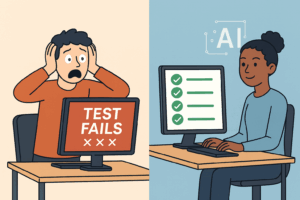
*Image generated by Copilot
Core Benefits of Using AI
The core value of AI in software testing is more than just speed; it’s about perspective.
AI can process massive amounts of historical test data, user interactions, and code modifications to detect patterns that testers might lose track of, particularly under tight deadlines. For instance, AI can correlate defect clusters with recent code commits to highlight modules that are statistically more prone to regression or edge-case failures. This means that teams are no longer predicting where the next problem will appear; rather, they are guided by intelligent insights. This translates to better sorting, a stronger emphasis on high-risk zones, and the potential discovery of edge cases that might otherwise go undetected during manual testing. In summary, AI complements human intuition with computer precision, allowing testers to perform less guesswork and more meaningful investigation.
Speed Up Testing and Remove Repetitive Work
AI helps identify repetitive regression scenarios that can be automated or validated through visual comparison tools. This allows testers to focus on high-risk scenarios and in-depth exploration. By automating the routine, AI enhances both efficiency and speed, freeing human testers to focus on their expertise where it is most needed.
Covering the Gaps with AI Insight
AI can highlight rarely used user workflows or edge inputs based on real use behaviour, which, combined with a defect history, helps testers identify high-risk zones. This enables teams to spot more bugs earlier and minimise blind spots, leading to deeper, more effective testing regardless of increasing effort.
Smarter Test Case Prioritisation
AI can be used to prioritise test cases based on risk, past defects, and code changes, to recommend which ones to run first or more often. This saves time on low-risk checks while improving the likelihood of detecting serious defects early, making manual testing smoother and focused.
Real-World Applications of AI in Testing
AI isn’t just an ongoing concept in software testing; it’s currently helping QA teams work smarter. From detecting difficult-to-find UI issues to organising exploratory testing, AI provides real, practical benefit that complements manual efforts and reveals what would otherwise go unnoticed. For example, Testim employs machine learning to automatically develop and manage automated tests, though Applitools applies computer vision to perform precise visual testing across devices and browsers. Similarly, ChatGPT-like NLP assistants can support testers in developing or refining test cases by analyzing user stories and converting them into structured test scenarios. AI technologies, for example, can analyse user session history to recommend areas of an application that users rarely explore, thus guiding testers to investigate and identify hidden issues in those less-tested features.
Visual Testing Using AI
Instead of relying upon the human eye to spot visual defects, AI can analyse screenshots and UI revisions with much better accuracy. It distinguishes between little visual noise and something that has a significant impact on the user experience, such as a broken layout or a moved button. By reducing false alarms, AI allows testers to focus on critical UI defects, while human reviewers continue to play an essential role in validating errors and ensuring that the final judgment is accurate and contextually aware.
AI-Assisted Exploratory Testing
Exploratory testing is where testers use their instincts to find hidden bugs, but even the best senses benefit from proper instruction. AI can direct testers to high-risk locations by analysing previous issues, user patterns, or latest code changes. It’s like having a smart assistant that highlights features, recently changed or known to be buggy, enabling testers to focus their exploratory sessions on the riskiest areas.
Automated Test Case Generation
Writing test cases from scratch takes quite a while when you have to consider every edge scenario. AI might help by automatically generating or suggesting test cases based on user flows, system behaviour, or even requirements documents. They still need to be reviewed to make sure they align with business logic and end conditions, but it’s starting to accelerate their creation.
Challenges and Limitations of Using AI in Testing
While AI offers significant advantages to software testing, it is not free of challenges. To get the best results out of AI, teams must be mindful of its existing limits and devise creative workarounds, especially while dealing with complicated, manual testing environments.
Data Dependency and Quality
AI systems learn from data, but if that data is lacking, out of date, or biased, the insights AI generates may be inaccurate. For example, if earlier bugs were inadequately documented or certain edge cases had never been tested, AI might be unable to reliably identify these risks. This emphasises the importance of supplying your AI technologies with clean, diverse, and sufficiently large datasets that reflect real-world scenarios. In summary, the accuracy and reliability of AI insights depend directly on the quality and quantity of the data it learns from.
Interpretability of AI Decisions
One popular concern regarding AI is the “black box” effect, which occurs when it flags issues or makes suggestions but does not always justify why. Understanding the reasons behind a suggestion is essential for testers, especially those working in regulated or risky environments. This is why explainable AI (XAI) approaches, which provide visibility into the reasoning behind AI outputs, are becoming essential for QA adoption. Without that transparency, it’s difficult to completely trust or rely on AI-generated insights.
Optimising Your QA Strategy with AI Integration: Best Practices
Successfully integrating AI into manual testing is not only about using the proper tools, but also about integrating them with your way of working. The following best practices assure that AI adds significant value despite affecting your current QA workflows.
POC with a Well-Defined Scope: Begin with a small, focused proof of concept that addresses a particular testing challenge, such as detecting corner cases in a high-risk component. Define success criteria early; for example, defect detection rate, time saved, or improved test coverage, to measure AI’s effectiveness before scaling.
Combine AI Tools with Human Oversight: AI can prioritise, suggest, or identify, but testers must still validate AI recommendations and make the final calls. A blend of automation and human judgment delivers more reliable results.
Train the Team Alongside AI Adoption: Introducing AI into QA requires a mentality shift, rather than just a tool. Ensure your team knows how the AI works, its limitations, and when human oversight is still required.
Conclusion
AI is transforming manual testing by helping teams in detecting hidden corner scenarios, improving coverage, and reducing redundant effort. Rather than replacing testers, AI enables smarter decisions through pattern identification, test prioritisation, and supervised exploration. Real-world technologies have already boosted the speed and reliability of processes such as visual validation and test case generation. However, success calls for careful integration, starting small, maintaining human oversight, and coaching teams along with the process. When utilised wisely, AI not only accelerates testing but also increases the tester’s roles, allowing QA teams to deliver higher-quality software with greater confidence.
Author:

Tahera Hussaini is a QA Engineer at Zartis. She focuses on improving software quality through effective testing and automation.
She is passionate about continuous learning and modern engineering practices.